






Back when flyers dropped announcing the next big Haitian event, excitement moved fast. Group chats lit up within minutes. Outfits were planned days in advance. Partygoers counted down to the weekend like it was a holiday. Lines formed before the doors even opened as everyone rushed to secure a spot close to the stage. Crowds wrapped around the block while music spilled into the street. The energy felt electric. Women stepped out in their best dresses and heels like it was a runway, and men showed up just as sharp, pressed, and polished, ready to be seen.
Every night out felt like a celebration of culture, style, and freedom. Those nights once felt guaranteed. Today, they feel uncertain.
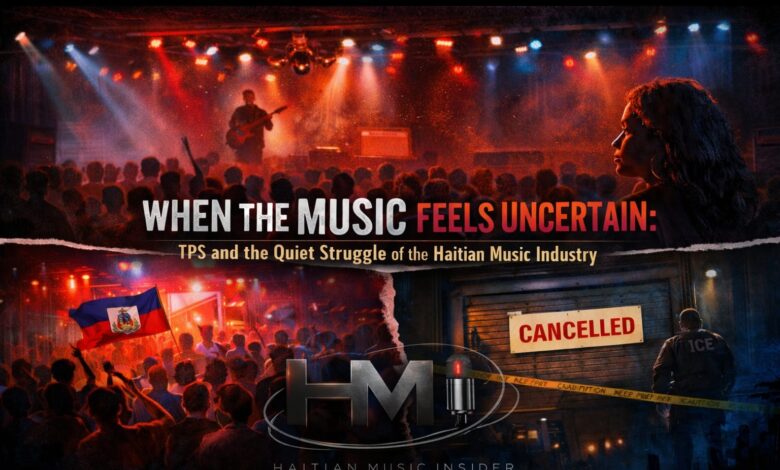
For the past year, the Haitian Music Industry has been quietly struggling under a weight that has nothing to do with talent, creativity, or demand. The passion for the music has never faded, and the community’s support has never disappeared. The real pressure comes from immigration uncertainty, especially for the thousands of Haitians who rely on Temporary Protected Status to live and work in the United States.
Temporary Protected Status, administered by U.S. Citizenship and Immigration Services, is a humanitarian program that allows people from countries facing extreme crises such as violence, political instability, or natural disasters to remain in the country legally. It grants work authorization and protection from deportation, enabling families to earn a living, pay taxes, build businesses, and contribute to their communities. For many Haitians, TPS has meant the difference between surviving in the shadows and building a stable life in plain sight. It provides the freedom to travel for jobs, sign contracts, and participate in everyday life without constant fear.
That stability became the foundation of the Haitian nightlife economy.
A large portion of musicians, DJs, promoters, vendors, and partygoers are TPS holders or arrived through humanitarian pathways. Each news alert about enforcement, each rumor about raids, and each mention of U.S. Immigration and Customs Enforcement activity creates hesitation. Even without official policy changes, fear spreads quickly and influences behavior. People begin to second guess simple decisions that once felt normal, like attending a party or traveling across state lines for a show.
The effects ripple across the entire industry. What was once a thriving cultural economy has slowed, not because people stopped loving the music, but because they no longer feel safe enough to gather freely. Musicians hesitate to accept bookings. Promoters downsize venues. Events that once sold out now struggle to fill the room. Vendors, photographers, bartenders, and sound crews lose opportunities. An entire ecosystem tightens.
Haitian music has always been more than entertainment for the diaspora. It is therapy, connection, and belonging. It is where language feels like home and stress melts into rhythm. It is where strangers become family for a few hours and grief, homesickness, and exhaustion are released on the dance floor. When people feel afraid to gather, that refuge begins to disappear. Celebration turns into caution, and joy becomes calculation, with many choosing to stay home rather than take the risk.
Although TPS has not officially ended, uncertainty alone has already wounded the scene. For immigrant communities, perception often carries as much weight as policy. When people feel vulnerable, they retreat, and when they retreat, culture grows quieter.
The Haitian Music Industry now operates in survival mode, adjusting rather than thriving. Still, Haitian culture has never depended on comfort to survive. The industry continues to adapt through day parties, smaller venues, outdoor gatherings, and private events that create safer ways for people to connect. The music will endure, as it always has, yet survival is not the same as prosperity. A thriving scene looks like packed rooms, live bands shaking the walls, and crowds dancing freely without watching the door.
With stability and peace of mind, those moments can return. The love for Haitian music has never disappeared. Many people are simply waiting to feel safe enough to show up again. When that confidence comes back, the dance floors will fill, the lines will wrap around the block, and the energy that once defined the Haitian Music Industry will rise just as powerfully as before.
Written by Fannie Rosario | French translation by Clifford Raphael
Écrit par Fannie Rosario | Traduction française par Clifford Raphael